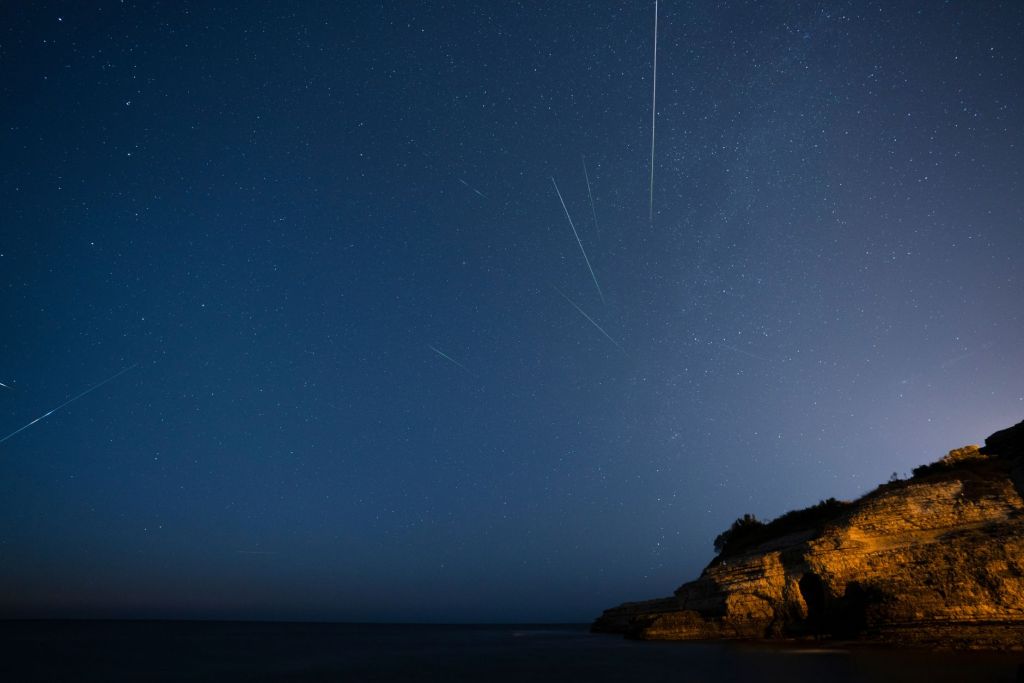
Looking for a free family outing that needs nothing more than a blanket and a little patience? The Leonid meteor shower peaks in just over a week, and this year the Moon is cooperating. Here is what to know so you can plan a night under the stars.
When to watch
The Leonids are active through most of November. Space.com lists the shower running from Nov. 6 to Nov. 30, while EarthSky notes Earth passes through the debris stream from about Nov. 3 to Dec. 2, so a stray Leonid can show up on almost any clear night this month.
The peak comes on Nov. 17-18. Space.com puts the predicted maximum at 6:45 p.m. EST on Nov. 17, and EarthSky gives 0 UTC on Nov. 18, which is about the same moment. Because the shower’s radiant does not rise until around midnight, the best viewing for North America is from midnight until dawn on the mornings of Nov. 17 and Nov. 18.
What you can expect to see
Set your expectations kindly, especially with children. Under a dark, moonless sky, both sources expect roughly 10 to 15 meteors an hour. City lights, clouds and haze cut that number, so a backyard in town may show only a handful.
The good news for 2026: the Moon will be near first quarter at the peak and sets around midnight, so it should be out of the way during the prime pre-dawn hours. EarthSky says scientists do not expect a Leonid storm this year, so think “steady show,” not fireworks.
Leonids are among the fastest meteors. Space.com, citing NASA, says they can hit the atmosphere at up to 44 miles per second, which is why many leave quick, bright streaks.
Where to look
The meteors appear to come from the constellation Leo, the lion. Look for “the Sickle,” a pattern shaped like a backward question mark that marks Leo’s head. EarthSky notes the radiant rises around midnight and is highest at dawn, and that Jupiter and Mars sit nearby this month, which can help you find your way.
Here is the tip most people miss: you do not need to stare at Leo. Meteors can flash anywhere in the sky. Lie back, take in as much sky as you can and let your eyes do the work.
A simple plan for families
- Pick your morning: Choose Nov. 17 or Nov. 18, then check the local forecast for clear skies.
- Go dark: Get away from streetlights if you safely can. A park, a rural road pull-off or even the darkest corner of your yard helps.
- Give your eyes 30 minutes: Space.com suggests about half an hour to adjust. Put phones away, or use a red flashlight.
- Skip the gear: No telescope or binoculars needed. A reclining chair or sleeping bag is better.
- Dress warm: Pre-dawn November air is cold. Bring layers, hats, gloves and a warm drink.
- Make it a game: Let kids count meteors or keep a tally of the brightest ones.
Where the Leonids come from
Every Leonid is a speck of dust left behind by Comet 55P/Tempel-Tuttle, which circles the Sun about every 33 years and is due back in 2031. When Earth crosses the comet’s trail each November, those tiny grains burn up high in the atmosphere.
The Leonids have a famous past. EarthSky recalls great storms in 1833 and 1966, and strong displays from 1999 to 2001. Space.com notes that 2026 marks 60 years since the 1966 storm, when some observers reported dozens of meteors per second.
Why it matters for families
A meteor shower is a rare kind of family time: no screens, no tickets, just wonder. It can also start good conversations about space, science and the size of the universe. For more sky ideas this month, see Look Up Together: Voyager’s Light-Day and a Sky Full of Wonder This November, and check our tips for staying warm and safe outdoors in Before the First Freeze.
Upstormed News will share a reminder as the peak gets closer.
Read more: Veterans Day 2026: What’s Open and Closed on Wednesday, Nov. 11
Will you be watching the Leonids? Tell us where you plan to look up in the comments.
Sources: Space.com, “Leonid meteor shower 2026: When and how to see November’s shooting stars” (November 2026); EarthSky, “Everything you need to know: Leonid meteor shower” (2026)




Leave a Reply