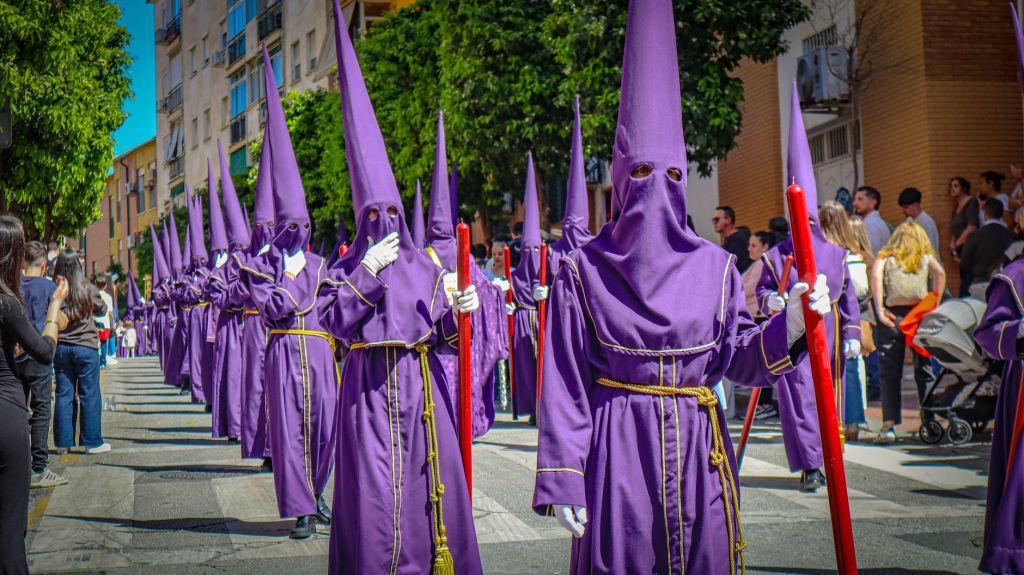
Every October, the streets of Lima, Peru, turn purple. Devotees put on purple habits tied with a white cord, and crowds gather along the streets. Then a painting of Christ on the cross moves slowly through the city.
Peruvians call October the “mes morado,” the purple month. It belongs to the Señor de los Milagros, the Lord of Miracles, also known with affection as the Cristo Moreno. This past weekend the devotion filled central Lima again, and its story is a moving picture of faith under pressure.
A Weekend of Processions
On Sunday, October 18, the second procession of the year left the Santuario de las Nazarenas at 6:00 a.m., after an open-air Mass led by Cardinal Carlos Castillo, the Archbishop of Lima. The image passed through the Plaza Mayor, where it was honored outside city hall, the Government Palace and the Archbishop’s palace. Lawmakers paid tribute in front of the Congress building. Late that night it came to rest at the Iglesia del Carmen.
On Monday, October 19, the third procession set out at 6:00 a.m. once more. This time the route carried the image to the people who could not come to it. It stopped at three hospitals along Avenida Grau, including a children’s emergency hospital, so patients and medical staff could pray. The image did not return to the sanctuary until about 3:28 a.m. on Tuesday, nearly a full day after it left.
There is more to come. The fourth procession is set for Wednesday, October 28, the central feast day, and will include a visit to the Hospital Arzobispo Loayza. The fifth and final procession is planned for Sunday, November 1.
A Painting on a Humble Wall
The story begins in the 1600s in Pachacamilla, a neighborhood of colonial Lima where enslaved Africans had settled and formed communities and church brotherhoods. On an adobe wall there, someone painted Christ crucified. Tradition says the artist was an enslaved man from Angola, working around 1651. His name is not known for certain, and Peru’s National Library says there is no conclusive record of who he was.
On November 13, 1655, an earthquake shook Lima and Callao. The walls around the painting were damaged. The wall holding the image of Christ stood. People took notice, and they began to gather there to pray.
Not everyone welcomed that. In 1671, authorities asked for the image to be erased and for the gatherings to stop. Tradition holds that several attempts were made to remove it, and none succeeded. That same year, permission was given to honor it instead, and the first Mass in its honor was held on September 14, 1671.
On October 20, 1687, another earthquake damaged the chapel built around the mural. Once again the painting survived. Sebastián de Antuñano, a key promoter of the devotion, arranged for a copy to be carried through the streets, and that walk is remembered as the beginning of the October processions. When a devastating earthquake struck on October 28, 1746, the faithful again turned to the image, which is why October 28 is the heart of the celebration today.
The original mural still hangs above the high altar of the Santuario de las Nazarenas in Lima’s historic center. The image carried in the processions is a canvas copy.
“God is our refuge and strength, a very present help in trouble. Therefore will not we fear, though the earth be removed, and though the mountains be carried into the midst of the sea;”
— Psalm 46:1-2 (KJV)
Why Purple?
The purple habit traces back to a 17th-century religious community promoted by Antonia Lucía del Espíritu Santo. According to religious accounts, the color came from a vision of Jesus dressed in purple. The white cord has five knots, which recall the wounds of Christ. Today people wear the habit as an act of penance, as a thank-you to God, or to keep a promise made in a hard season.
The processions are full of other traditions too. Teams of bearers, called cuadrillas, take turns carrying the platform, called an anda, on their shoulders. Incense bearers called sahumadoras walk with the image, and cantoras sing hymns. Along the routes, families enjoy a traditional sweet called turrón de Doña Pepa, which popular tradition links to Josefa Marmanillo, an Afro-Peruvian woman from Cañete.
The devotion has also traveled. Peruvian families living abroad hold their own Masses and processions every October in cities around the world.
What We Can Learn From the Purple Month
- Faith can start small. It began with one painting on a mud-brick wall, made by a man whose name history did not keep. God saw him.
- Take hope to the hurting. The processions do not only pass grand buildings. They stop at hospitals, so the sick are not left out.
- Carry the load together. The anda is carried by teams, not by one person. The cuadrillas take turns, shoulder to shoulder, through long days and longer nights.
- What God holds up, stands. Earthquakes came again and again. The people of Lima rebuilt, and they kept praying.
Whatever shaking you are facing this season, you are not walking alone. Through every storm, we rise together.
Is there a tradition in your family or your country that helps you remember God’s faithfulness in hard times?
Sources: Infobae, “Señor de los Milagros en Lima: así fue el segundo recorrido de la imagen del Cristo Moreno el domingo 18 de octubre” (October 18, 2026); El Comercio, “Procesión del Señor de los Milagros 2026: rutas y horarios para este domingo 18 y lunes 19” (October 18, 2026); Infobae, “Procesión del Señor de los Milagros: revive el tercer recorrido del Cristo Moreno en 2026” (October 19, 2026); Infobae, “¿Cuándo será el cuarto recorrido del Señor de los Milagros 2026?” (October 20, 2026); Infobae, “La pintura original del Señor de los Milagros: historia del mural que sobrevivió a un terremoto” (October 17, 2026); Infobae, “Señor de los Milagros: la historia del Cristo Moreno y el origen de una de las mayores devociones del Perú” (October 16, 2026); King James Bible Online, Psalm 46.


Leave a Reply