Oil prices took their steepest fall in about three months on Monday, November 2, as hopes grew that the United States and Iran could return to the negotiating table. The drop arrived as drivers were already seeing a little relief at the gas pump, though analysts cautioned that the break could be short-lived.
U.S. crude oil, known as West Texas Intermediate, settled at $96.46 a barrel for December delivery, down 7.4%, according to Bloomberg reporting published by Rigzone. That pushed U.S. crude back below $100 a barrel. Brent crude, the global benchmark, closed 7.6% lower at $104.77. European natural gas futures fell nearly 11% at one point, and U.S. heating oil had its biggest one-day drop in six months.
What drove the drop
The slide followed signals from both Washington and Tehran that diplomacy may get another chance. Iran’s state-run news agency IRNA reported that the country’s supreme leader approved the government pursuing negotiations. Semafor reported that Brent fell to a two-week low after President Donald Trump hinted at progress in talks.
Spectrum News reported that, after three days of weekend talks between Qatari and Iranian officials, Iran’s foreign ministry said it had a two-day plan to reopen the Strait of Hormuz and resume nuclear talks with the United States. The strait is a narrow waterway that a large share of the world’s oil normally passes through.
President Trump told the Right Side Broadcasting Network on Sunday that the war would end soon, one way or another, according to Spectrum News. Secretary of State Marco Rubio said the president had not decided whether to resolve the conflict militarily or diplomatically, while adding that he would prefer a peaceful outcome. Iran’s top diplomat said he hoped the U.S. would show rationality as both sides work to avoid a return to fighting. Bloomberg reported that, when asked whether he would resume strikes on Iran after Tuesday’s vote, the president answered no, according to a media pool report.
A lot of risk premium is seeping out of both crude oil and European natural gas.
Darrell Fletcher, Bannockburn Capital Markets, via Bloomberg
That “risk premium” is the extra cost traders build into prices when they worry supplies could be cut off.
What it means at the pump
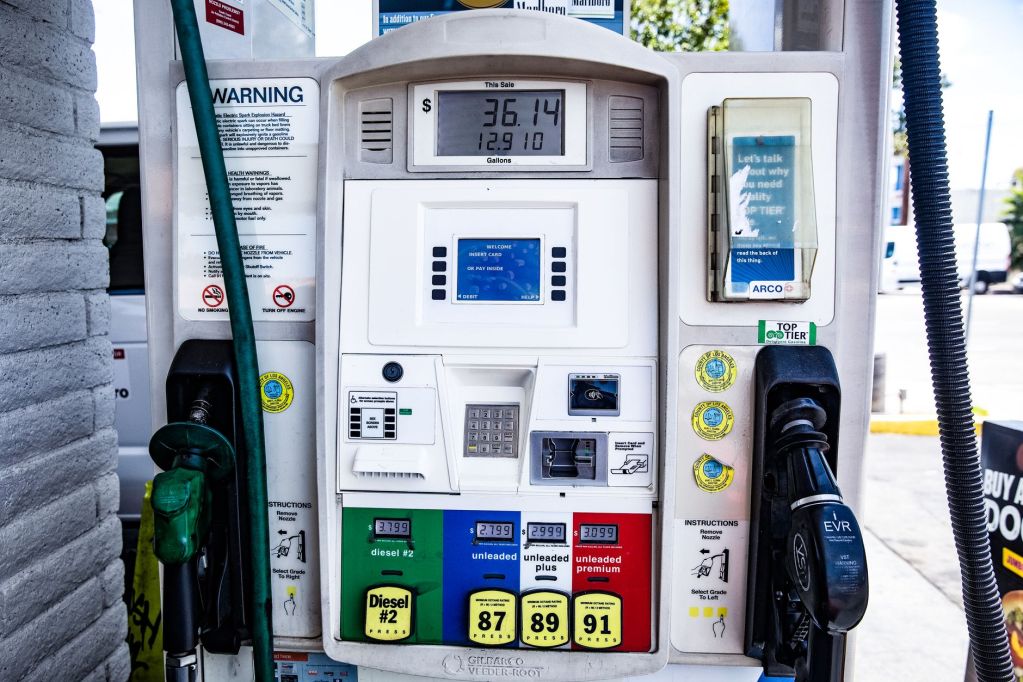
Drivers have already started to feel some relief. AAA’s national average for regular gasoline was $4.17 a gallon on Monday, down 12 cents from a week earlier, Spectrum News reported. That is still well above the $3.04 drivers paid a year ago. Diesel, which affects the cost of shipping nearly everything families buy, averaged $6.29 a gallon, down 6 cents in a week but far above last year’s $3.68.
Oil prices have swung widely since the conflict began in late February. Brent has traded between $72 and $126 a barrel in that time, compared with about $65 a year ago, according to Spectrum News.
Why analysts urge caution
Experts warned that one good day does not settle the bigger picture. Patrick De Haan, head of petroleum analysis at GasBuddy, wrote that volatility “could return quickly after the election,” Spectrum News reported. He said prices will depend on whether new attacks occur or a truce takes hold around the Strait of Hormuz, and on continued Ukrainian strikes on Russian refineries.
UBS commodities analyst Giovanni Staunovo said the oil market is still reacting with extreme sensitivity to every headline out of the Middle East. Goldman Sachs raised its December forecast for Brent from $90 to $105 a barrel, citing risks such as shipping attacks and damage to oil infrastructure.
Bloomberg noted that the two countries have not agreed on terms for fully reopening the Strait of Hormuz, and that earlier diplomatic efforts have stalled. Semafor reported that some analysts view the positive signals as possibly tactical ahead of Tuesday’s midterm elections. Separately, Kazakhstan temporarily halted crude flows toward Russia through a pipeline after a drone strike, another reminder of how fragile supply remains.
A mixed day for the wider economy
The oil news came alongside other economic reports, StockTitan reported. U.S. factory activity beat forecasts, with the ISM manufacturing index rising to 55.5 in October, above the 54.5 economists expected. Construction spending, however, fell 1.9% in September when a small rise had been forecast. On Wall Street, the Dow edged higher while the tech-heavy Nasdaq fell about 1%.
What to watch next
- Whether U.S.-Iran talks lead to a reopening of the Strait of Hormuz.
- How energy markets react after Tuesday’s midterm elections.
- A federal job openings report on Tuesday and the October jobs report due Friday, where economists expect about 55,000 new jobs, according to StockTitan.
- Weekly gas price updates from AAA heading into the holiday travel season.
Why it matters for families
Fuel costs touch almost every household budget, from the daily commute to the price of groceries delivered by diesel trucks. Monday’s drop offers a little breathing room, but prices are still about $1.13 a gallon higher than a year ago, and experts say they could jump again quickly. Families planning Thanksgiving road trips may want to build some extra room into their travel budgets, compare prices with a gas app before filling up, and combine errands to save fuel.
Sources: Spectrum News, “Gas, diesel, oil prices are down, but reprieve could be temporary” (November 2, 2026); Bloomberg via Rigzone, “Oil Prices Sink as Iran Signals Talks” (November 2, 2026); Semafor via Yahoo Finance, “Oil prices fall on US-Iran negotiations” (November 2, 2026); StockTitan, “Tech Stocks Pulled the Nasdaq Lower in the Stock Market Today, November 2, 2026, as Oil Tumbled” (November 2, 2026)




Leave a Reply