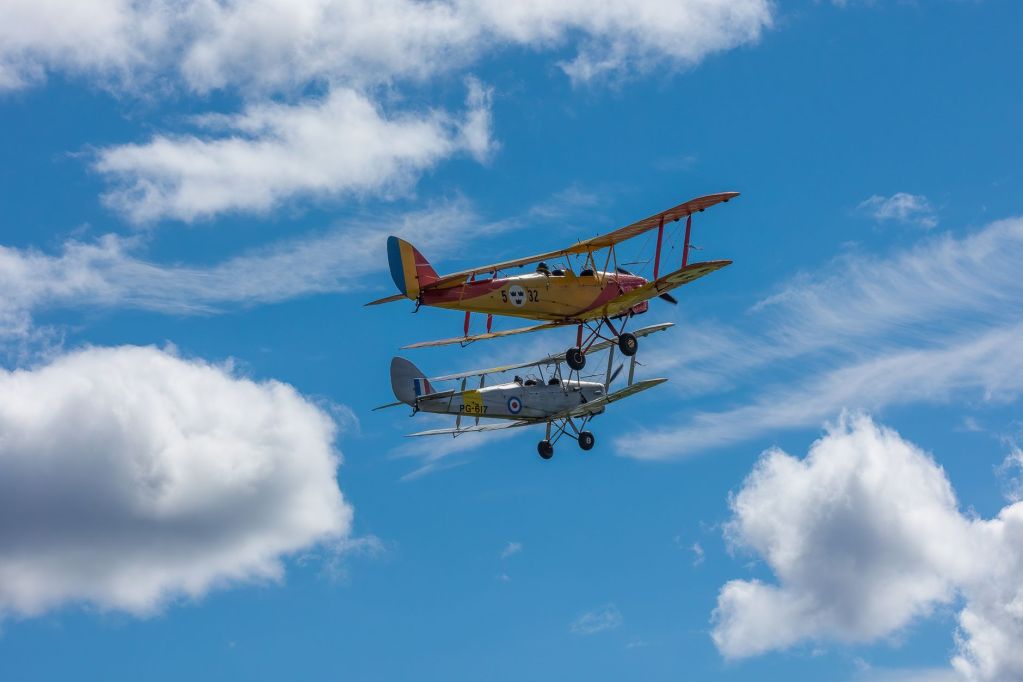
Picture a young woman in the early 1920s sitting in a Chicago barbershop, filing fingernails and listening. The customers are talking about the pilots who flew in the Great War. Most people would hear those stories and simply go back to work. Bessie Coleman heard them and decided she would fly.
There was just one problem. Every door seemed to be shut.
A Hard Start in Texas
Elizabeth “Bessie” Coleman was born on January 26, 1892, in Texas and grew up in Waxahachie, one of thirteen children. Her mother, Susan, washed clothes for long hours to keep the family going. Bessie helped where she could, and she read every book she could find, including the Bible.
She finished high school and enrolled at Langston University, a historically Black college in Oklahoma. But money ran out after one semester, and she had to leave. It would have been easy to decide that big dreams were for other people.
Chicago and a New Idea
Like many Black Southerners of her time, Bessie moved north to Chicago, where an older brother was already living. She trained as a beautician and worked as a manicurist, and she later managed a chili parlor. It was in that barbershop, listening to talk about wartime pilots, that her interest in flying caught fire.
She tried to find a flight school in the United States. None would accept her, because she was Black and because she was a woman.
Instead of giving up, she found another way. With encouragement from Robert S. Abbott, publisher of the Chicago Defender newspaper, she studied French and saved her earnings. In November 1920 she entered the Caudron aviation school in Le Crotoy, France.
June 15, 1921: Wings at Last
On June 15, 1921, Bessie Coleman earned an international pilot’s license from the Fédération Aéronautique Internationale. The Chicago History Museum describes her as the first Black woman in the world to earn an aviator’s license. She came home to the United States that September.
Flying jobs were scarce, so she became a barnstormer, an exhibition pilot who thrilled crowds with loops and figure eights. Newspapers nicknamed her “Queen Bess.” On October 15, 1922, more than 2,000 people came to see her fly at Checkerboard Field near Chicago.
Standing Firm on the Ground, Too
Her courage was not only in the air. Coleman refused to perform at events where Black spectators were forced to use separate gates or seating. If her own community would not be treated fairly, she was willing to cancel the show. For a performer who depended on ticket sales, that was a real cost, and she paid it.
She also carried a dream bigger than herself: to open a flight school where African American students could learn to fly without facing the closed doors she had faced.
A Short Life With a Long Reach
Bessie Coleman died on April 30, 1926, in an accident during a rehearsal flight in Jacksonville, Florida. She was only 34, and she was buried in Chicago.
She never got to open her school. But her example kept working long after she was gone. According to the Chicago History Museum, she inspired the Challenger Air Pilots Association, founded in 1931, which opened an airport in Robbins, Illinois, in 1933 for Black pilots who were turned away elsewhere. Her story is often linked to the generations of Black aviators who followed, including the Tuskegee Airmen.
“He maketh my feet like hinds’ feet, and setteth me upon my high places.”
— Psalm 18:33 (KJV)
What Bessie’s Story Teaches Our Families
Most of us will never fly a biplane. But nearly all of us will hear the word “no” at some point. Bessie’s life offers a few lessons worth sharing around the table this week:
- A closed door is not always the end of the road. When American schools said no, she learned a new language and crossed an ocean.
- Small, steady work builds big dreams. Her flight training was paid for by ordinary jobs, one manicure and one bowl of chili at a time.
- Accept help with gratitude. She did not do it alone. A mentor believed in her, and a community cheered her on.
- Success is a chance to lift others. She used her fame to stand up for fair treatment and dreamed of training the next generation.
Here is a simple family activity: ask each person to name one “no” they have heard, then brainstorm together a “different way around” it, the way Bessie found her way to France. Children may be surprised how many creative paths open up when a whole family starts thinking.
Through every storm, we rise together. Bessie Coleman rose higher than almost anyone of her day thought possible, and she did it with her eyes on the people coming after her.
Who in your life found a different way around a closed door, and what did their example teach you?
Sources: America’s Black Holocaust Museum, “Bessie Coleman: Breaking Barriers in the Sky (1892 to 1926)” (accessed November 18, 2026); Chicago History Museum, “Bessie Coleman, Aviation Pioneer” (January 26, 2021)



Leave a Reply