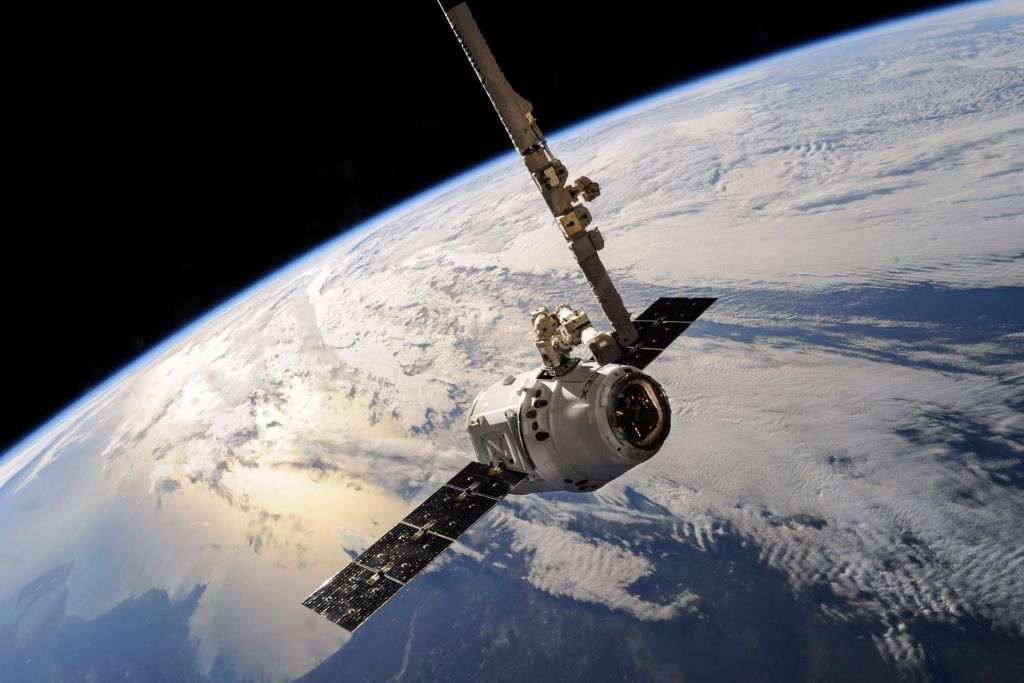
A European-Japanese spacecraft is now circling Mercury, the smallest planet and the one closest to the Sun, after an eight-year journey and a nail-biting software glitch during its final braking burn. The European Space Agency (ESA) confirmed that BepiColombo entered orbit around Mercury on Saturday, Nov. 21, and said the mission remains safe and on track.
What happened
BepiColombo, a joint mission of ESA and the Japan Aerospace Exploration Agency (JAXA), launched in October 2018. Its orbit insertion began at 18:24 UTC on Nov. 21, ESA said, starting with a planned loss of contact with mission control at ESA’s European Space Operations Center in Darmstadt, Germany.
During that blackout, four thrusters fired as the spacecraft passed over Mercury to slow it down, bringing it within about 400 miles of the surface, CBS News reported. The burn was planned to last about 37 minutes. But when contact returned, controllers found the spacecraft in safe mode, a protective state in which nonessential activity stops. A problem had ended the burn early.
CBS News reported that trajectory data showed only about 77% of the maneuver had been completed. Even so, the planet’s gravity captured the spacecraft, and ESA confirmed it was in orbit about six hours after the maneuver began.
“Upon finding Bepi in safe mode, it was like flipping a switch.” — Ignacio Tanco, ESA BepiColombo flight operations director, to CBS News
A software glitch and a longer orbit
Teams at ESA’s operations center, working with manufacturer Airbus and JAXA, traced the issue to a software glitch, ESA said. CBS News reported the problem involved attitude guidance and thruster control, and that the investigation is ongoing.
Because the burn was cut short, BepiColombo settled into a 75-hour orbit instead of the planned 58-hour orbit, according to ESA. The agency said its remaining maneuvers have been adapted to the new path, so no extra thruster burns are needed. Over the coming weeks, small burns will gradually shape the orbit, a process ESA compared to braking a car at just the right moment.
The arrival also made history: ESA said it was the first planetary orbit insertion to use a technique called “weak stability capture,” which involves arriving at lower speeds than usual. Until now, only some spacecraft heading to Earth’s Moon had used the approach.
What comes next
BepiColombo is really two science spacecraft traveling together. ESA said the orbit change does not affect the planned Dec. 9-10 separation of the two orbiters:
- Mercury Planetary Orbiter (MPO): Built by ESA, it will study Mercury’s interior and surface. CBS News reported it is expected to reach its final orbit in March 2027.
- Mercury Magnetospheric Orbiter (Mio): Built by JAXA, it will study Mercury’s magnetic environment, dust between the planets and electric fields.
A sunshield that protects the Japanese orbiter, known as MOSIF, is scheduled to separate on Dec. 16, ESA said. The main science phase is set to begin in April 2027.
Why it matters for families
BepiColombo is a real-world lesson in patience and problem-solving: a team spent eight years flying a spacecraft across the solar system, hit a surprise glitch at the most important moment, and still found a way to succeed. For curious kids, it is a great way to talk about:
- Why Mercury, the closest planet to the Sun, took eight years to reach.
- How countries work together in space, with Europe and Japan sharing one mission.
- How engineers plan backups so that one problem does not end a mission.
The first close-up science from Mercury’s orbit is still months away. Upstormed News will follow the orbiters’ separation in December and the start of science operations next year.
Related coverage
- ULA’s Vulcan Rocket Fails 10 Minutes Into Flight, Losing 40 Amazon Leo Satellites
- COP31 Climate Summit Collapses With No Deal After Fossil Fuel Standoff
Read more: EU unveils 22nd Russia sanctions package targeting banks, crypto, tankers and sports
If you could send a spacecraft to any planet, which one would you choose and why?
Sources: CBS News, “Spacecraft enters Mercury’s orbit after 8-year journey despite glitch” (November 24, 2026); European Space Agency, “Latest updates: BepiColombo’s arrival at Mercury” (November 23, 2026)



Leave a Reply